
Multi-Tenant and Role-Based (RBAC) Integrated Management System in Global Textile Supply Chain
Project: AJ International ERP
Access URL: app-tekstil.acrtech.com.tr
Document Type: Technical Architecture and System Analysis Article
Abstract
This article examines the cloud-based enterprise resource planning (ERP) system developed for AJ International operations, managing geographically distributed (Turkey, Russia, Dubai) business processes through a single core software.
The study discusses the "Multi-Tenant" architecture created with the hybrid use of Next.js 14, Spring Boot, and MongoDB technologies and the RBAC (Role-Based Access Control) mechanism actively working in the system with technical details. The system is a verified software solution running in a live environment that ensures data isolation while maintaining centralized management capabilities.
1. Introduction
The textile sector requires a complex data model due to its variant product structure (color, size, fabric type) and cross-border logistics processes.
The AJ International project has adopted a non-monolithic, modern service-based architecture to manage this complexity. The system combines operations in Turkey, Russia, and Dubai, each with its own legal and commercial rules, in an infrastructure that is logically separated but physically runs on a single database cluster.
2. System Architecture and Technology Stack
The project is structured where Frontend and Backend layers operate completely independently, in accordance with the "Separation of Concerns" principle.
2.1. Frontend Architecture (Client Layer)
The user experience is built on the Next.js 14 (App Router) architecture due to its server-side rendering (SSR) capability and SEO compatibility.
-
Component Library: Reusable and lightweight UI components compliant with atomic design principles have been developed using Shadcn/ui and TailwindCSS.
-
State Management: Complex form data and user session information are managed on the global state with the Zustand library.
-
Data Fetching: Data synchronization between server and client is optimized, and network requests are minimized with SWR or TanStack Query patterns.
2.2. Backend Architecture (Server Layer)
Business Logic runs on Spring Boot 3.x, the standard of the enterprise Java ecosystem.
-
Database: MongoDB (NoSQL). The hierarchical and variable structure of textile products (e.g., a product having N color variants and each variant having M size stocks) necessitated a document-oriented structure rather than relational databases.
-
API Gateway: All requests are met through endpoints designed in accordance with RESTful API standards.
3. Security Architecture and Access Control
The system's security layer is a currently active structure covering not only Authentication but also detailed Authorization.
3.1. Role-Based Access Control (RBAC)
In the system, users access specific resources according to their assigned roles. This structure works on the Spring Security Filter Chain with the following logic:
Permission(u) = Union( Roles(u) -> Permissions(r) )
The following hierarchy is actively applied in the system:
-
Super Admin (Root): Authority to manage all tenants (countries) and configurations.
-
Country Admin (Tenant Admin): Manages only users, stocks, and finance in their own country (e.g., TR, RU, or DU). Cannot see data of other countries.
-
Operational User: Has authority only for data entry and viewing; deletion or configuration authority is restricted.
3.2. Authentication (JWT & HttpOnly)
The system has a "Stateless" architecture.
-
When the user logs in, the server generates a signed JWT (JSON Web Token).
-
This token is stored in an HttpOnly Cookie inaccessible by JavaScript on the client side. This method provides full protection against XSS (Cross-Site Scripting) attacks.
4. Multi-Tenancy and Data Isolation
The system uses the "Discriminator Column" strategy, not "Database-per-Schema," where a single software instance serves multiple organizations.
-
Tenant Context: Every HTTP request is captured by an Interceptor.
-
Data Filtering: The
tenant_id(e.g., tr, ru, du) is read from the request header (Header) or the logged-in user's profile. -
MongoDB Query: The backend automatically adds the
{ tenant: "current_tenant" }criterion to every query going to the database. In this way, it is made technically impossible for a Russia user to access Turkey data by manipulating the API.
5. Module and Functional Details
The AJ International system consists of the following main modules managing textile operations end-to-end:
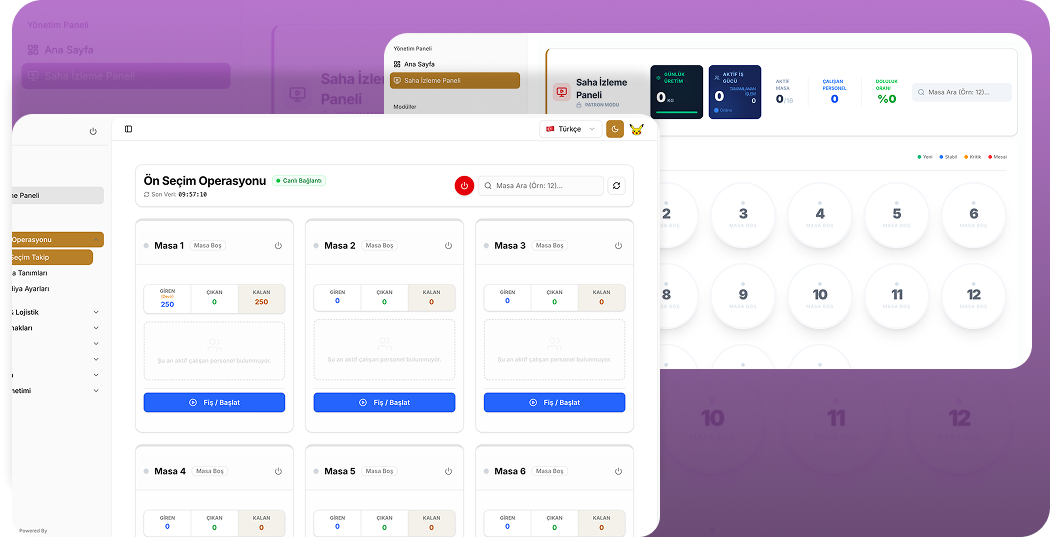
5.1. Dashboard and Management Panel
The screen the user first encounters is dynamically shaped according to the authorization level.
-
KPI Cards: Metrics such as total sales, active orders, and critical stock levels are calculated instantly.
-
Graphical Analysis: Sales trends and stock distribution are visualized.
5.2. Product and Inventory Management (PIM & WMS)
This module, the heart of the textile sector, covers variant management down to the finest detail.
-
Variant Matrix: Sub-breakdowns (SKU) such as Color, Size, Fabric Type are managed under a Parent Product.
-
Stock Movements: Entry, exit, transfer, and return transactions are logged. Which product is in which warehouse (TR Warehouse, RU Warehouse) and how much is tracked instantly.
5.3. Current Account and Customer Relations (CRM)
Designed for B2B operations.
-
Customer Cards: Each country's own customer portfolio is isolated.
-
Balance Tracking: Customers' debt/credit status and order-based offsetting transactions are carried out through the system.
5.4. Sales and Order Management
Covers the process from the moment the order is received until delivery.
-
Order Creation: Order form working with basket logic, including dynamic pricing.
-
Status Management: Workflow tracking through "Pending", "Preparing", "Shipped", "Delivered" statuses.
6. Live Demo and Operational Verification
The system's "Multi-Tenant" structure and RBAC capabilities can be verified on the live environment below. These access details prove the system's isolation capability and the operability of the modules.
Project URL: https://app-tekstil.acrtech.com.tr
Administrator accounts defined to test the system with isolated privileges are:
| Operation Region | Username | Password | Access Scope |
| :--- | :--- | :--- | :--- |
| Turkey Operation | admin.tr | admin | Only TR products and current accounts. |
| Russia Operation | admin.ru | admin | Only RU logistics and stocks. |
| Dubai Operation | admin.du | admin | Middle East market data. |
Note: When logged in with each user, although the modules in the left menu appear the same, it will be seen that the data inside (Product list, Customer list) are completely different.
7. Conclusion
The AJ International project is a modern SaaS solution with an RBAC structure that does not compromise on security, a high-performance Next.js front end, and a flexible MongoDB database architecture.
The system is currently serving actively not just as a data recording environment, but as an integrated platform where operational decisions are made, and cross-regional data isolation is provided with mathematical certainty.